

 Alex
Habibi
Alex
Habibi
July is when the calls pile up across the Waterloo Region. The first heat wave lands, every system kicks on at once, and the weak ones give out. An AC not blowing cold air is the breakdown that floods every shop during a hot stretch.
During that rush, the wait for AC repair in Kitchener can stretch past a week, and a wasted diagnostic fee is money you would rather keep. Before you wait days for a technician, a handful of quick inspections can rule out the easy causes or resolve the problem outright.
Why Your AC Isn't Blowing Cold Air
Your air conditioner does not produce cold air, and it transfers heat out of the house, using refrigerant to absorb warmth from indoor air and release it outdoors. For that to work, three things must line up, steady airflow across the coils, the correct refrigerant charge, and power to both the blower and the outdoor unit. When one of those slips, the vents blow warm, weak, or nothing.
The U.S. Department of Energy keeps a homeowner rundown of common air conditioner problems. The first line of it says the same thing, inspect the simpler items before contacting a professional. Most no-cooling calls trace back to a setting, a dirty filter, a tripped breaker, or a blocked outdoor unit.
The symptom points to the cause, and an AC running but not cooling often means a refrigerant or coil problem. Weak but cool air usually means airflow, like a filter or a dirty blower. No air at all points to power or the thermostat. None of this means skipping a repair, just not paying a diagnostic fee for a dead battery or tripped breaker. Five minutes of troubleshooting with the checklist below tells you whether it's a you problem or a technician problem.
Start With the Thermostat
It sounds obvious, and it still resolves more no-cooling calls than anything else. Set the thermostat to cool rather than fan, and drop the target below the room temperature, because on fan the system simply recirculates room-temperature air, which feels exactly like an air conditioner that has quit.
Battery-powered thermostats are frequently overlooked, and weak batteries can stop the unit from calling for cooling even when the display still lights. And cranking the dial to 16°C won't cool the house faster, it just runs longer than it needs to.
Where the thermostat sits matters too, because one mounted near a sunny window or a heat source reads high and short cycles the entire system. In a lot of KW homes, it sits on a wall that bakes in afternoon sun, throwing the reading off.
Check Power at the Breaker
A central AC draws power from two places, and homeowners usually forget the second one. The indoor blower runs off the furnace circuit, while the outdoor unit has its own breaker and a separate disconnect box on the exterior wall.
If the inside fan hums but the outdoor unit sits silent, a tripped breaker is the most probable culprit. Reset it once, and if it trips again immediately, leave it off, because a breaker that repeatedly trips indicates an electrical malfunction rather than a nuisance you should continue resetting.
Heat waves are when this shows up because every AC in the region runs flat out, the grid strains, and a marginal breaker finally trips. One reset is fine to attempt, and a repeated pattern of tripping is a signal to stop and call.
A Clogged Filter Starves the System
A dirty filter is responsible for more weak-airflow calls than anything else on this list. When the filter becomes clogged, the blower cannot draw enough air across the cold coil, and what reaches the vents is a thin, lukewarm trickle instead of a strong, cold stream. Pull the filter out and hold it up against the light, and if you cannot see light through it, it needs replacing.
Most require replacement every one to three months during summer, and sooner if you have pets or operate the system intensively. One caution on filters, a thick, high-MERV allergy filter can choke an older blower that was not built for it. Match the filter to what your system can pull and change it more often instead of buying the densest one.
Neglect the filter long enough and the situation deteriorates rather than improves. Natural Resources Canada points out that dirty filters and coils cut airflow. That reduces both efficiency and cooling capacity, and over time it can cause expensive compressor damage. Restricted airflow is also what sets up the following problem, a coil that freezes completely.
Check Your Vents and Returns
Airflow problems are not always at the filter, because supply registers shut or blocked by furniture will choke the air your system worked to cool. Return grilles matter even more, since that's where the system draws air back to chill it.
Walk through the house and open every supply register, even in rooms you do not use, because closing them does not save much and it disrupts the balance the system was originally configured for. Many older KW homes run on a single central return, so one couch over that grille cuts airflow everywhere.
When Ice Builds on the Coil
It frequently catches homeowners off guard, the air's barely cool, yet the coil or copper line is encased in frost. A frozen coil cannot absorb heat from the air, so the ice continues accumulating while the air conditioner keeps blowing warm air.
If you discover ice, switch the system off at the thermostat and set the fan to on, which circulates room air over the coil and gradually melts the accumulation over several hours. Don't chip at it, though, because you can puncture the coil and turn a cheap repair into an expensive one.
All that meltwater must go somewhere, it drains through a condensate line, and if that line clogs, a float switch shuts the system down. An obstructed drain or a full pan near the indoor unit is worth clearing before you blame anything else.
Once it thaws, the cause is always one of two possibilities, a clogged filter restricting airflow, or insufficient refrigerant. You can handle the filter, but if a fresh one doesn't stop the freezing, the refrigerant side needs a technician.
Give the Outdoor Unit Room to Work
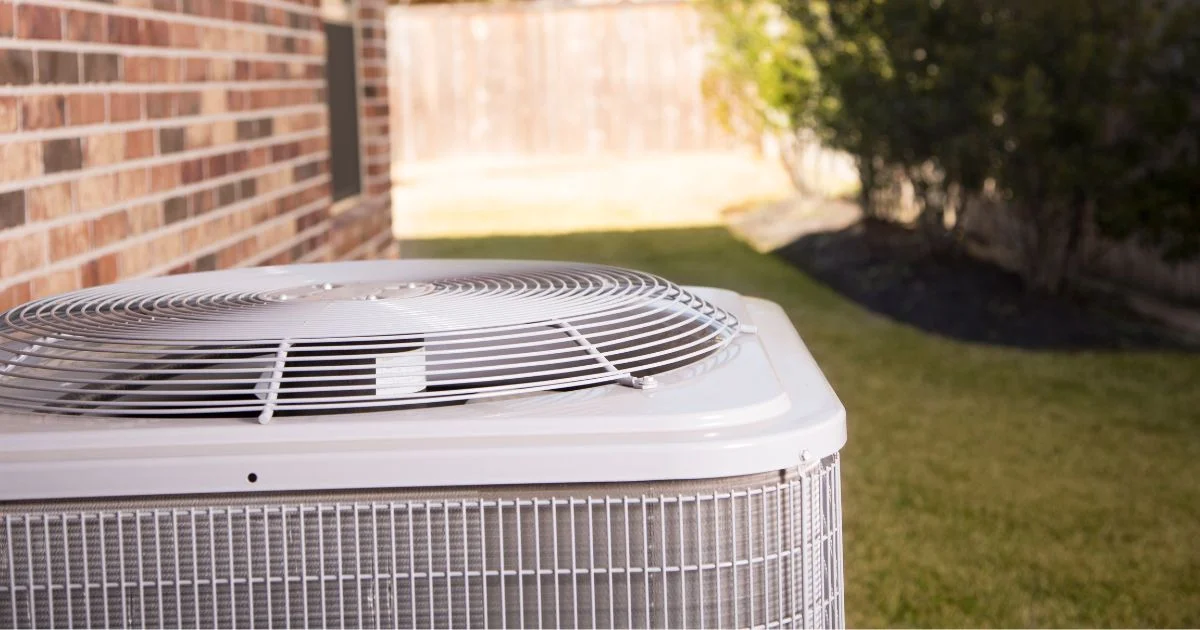
The outdoor unit's responsibility is to expel your home's heat into the surrounding air. When grass clippings, leaves, or cottonwood fluff pack the fins, it cannot dissipate that heat, and cooling efficiency declines rapidly.
Shut the power off at the disconnect first, then clear leaves and growth back about two feet on all sides. Hose the fins gently from the inside out, never with a pressure washer since they bend with almost no force. Packed or bent fins are a frequent reason a system that seems fine cannot keep up in the heat.
June is the worst stretch here, when cottonwood fluff drifts everywhere and mats against the coil like felt, so a unit tucked behind a fence or deck for looks still needs room to breathe.
Sometimes It's Just Too Hot Out
Not every case of an air conditioner not cooling is a malfunction, because a central AC pulls indoor temperature down a set amount below outdoor, not to any number you pick. On a 33°C afternoon, holding the house in the low 20s means the system runs continuously, which is normal.
Close the blinds on the sunny side and run ceiling fans to take the edge off, and if the house keeps pace on milder days but only falls behind during extreme heat, the system is performing adequately. Even a healthy system needs time, so give it the afternoon before evaluating it. A unit that cannot keep up even on an average day is the one worth a closer inspection.
What Actually Needs a Technician
Some problems are not a homeowner job, and pushing past them costs more than it saves, and low refrigerant is the clearest example, because it does not deplete on its own. If the charge is down, there's a leak, and recharging it without fixing that just postpones the failure. Refrigerant work is also regulated, and handling it legally requires certification, not a kit from a hardware store.
The same goes for a failed capacitor, a dead compressor, or burnt contactor points, and a deteriorating capacitor often presents as a persistent hum from an outdoor unit that fails to start. That is where a full-system diagnosis pays off, instead of replacing whatever part is loudest.
Plenty of midsummer breakdowns trace straight back to spring, when the system started up without an inspection, and these checks overlap with that same startup routine. The full set of steps for switching on your air conditioner is worth running before next year's first sweltering day. Run these inspections and you will resolve a good share of no-cooling calls yourself or at least know it is real.
When the simple causes are ruled out and the AC still is not blowing cold air, the refrigerant and electrical work is where our licensed technicians take over. They cover the Waterloo Region, so call us at 519-741-5100 once the checklist runs out and the house is still warm.